Japanese Tea
How to Order at a Kissaten: The Only Japanese You Actually Need
The first thing to know about a kissaten is that the check lands on your table before you’ve received anything — sometimes before you’ve said a word. Nobody is rushing you. You could sit there for three hours over one coffee and the owner would consider that entirely proper use of the room.
This site is called The Kissa Club because of these places. 喫茶 (kissa) literally means “tea drinking” — the word walked into Japanese from Zen temples centuries ago — and then, in one of history’s small jokes, the 喫茶店 (kissaten) that carry the name became Japan’s great coffee institutions: Shōwa-era rooms with dark wood, amber lamps, jazz or classical on real speakers, and a menu that has not changed since your grandfather’s first date.
Tourists walk past them because the facade looks private. Here’s the vocabulary that gets you through the door.
ブレンド (burendo) — the entire menu in one word
Every kissaten has a house blend, and ordering it is a complete sentence: “Burendo hitotsu kudasai” — one blend, please. In Tokyo it’ll run between ¥450 and ¥550, hand-poured, served in a cup and saucer the owner chose forty years ago.
Want it iced? アイス (aisu) — “Aisu kōhī kudasai.” Hot is ホット (hotto), and yes, you can just say “Hotto de” and be understood perfectly. Katakana English is real Japanese; use it shamelessly.
I drink green tea at home in the morning and coffee at the kissaten — Japan never asks you to pick a side. If anything the two habits share a temperament: nobody’s in a hurry, and the good stuff is brewed at a temperature, not a speed.
モーニング (mōningu) — the best deal in Japanese food
Order any drink before about 11 a.m. and many kissaten will bring you a morning set: thick-cut toast, a boiled egg, sometimes a tiny salad — free, or nearly free, with your coffee. You don’t order it so much as fail to refuse it: “Mōningu tsukemasu ka?” (shall I add the morning?) — say “Onegaishimasu.”
In Nagoya, where the custom was born, the arms race got out of hand decades ago and a ¥500 coffee can arrive with a small breakfast buffet. Tokyo is more restrained. Either way it is the cheapest sit-down breakfast in the country and possibly the best value in Japanese food.
クリームソーダ (kurīmu sōda) — order the ridiculous thing
Melon soda — a green that exists nowhere in nature — with a scoop of vanilla ice cream slowly capsizing into it. It is the unofficial mascot of the kissaten revival, and ordering one as an adult is completely normal.
The kissaten near my wife’s family home in Tango, on the north coast of Kyoto where the tourists never get to, has exactly four things on the menu, and the cream soda is the only one anyone orders in summer. Her family has been going there so long that nobody’s ordered out loud in years — sitting down is the order. That’s the level of regularhood (常連, jōren) to aspire to.
The support vocabulary
- お冷 (ohiya) — the free ice water that appears instantly. Refilled forever, no charge, no tipping. Ever.
- おしぼり (oshibori) — the hand towel that comes with it. Wipe hands, not face (officially).
- すみません (sumimasen) — the correct way to call staff. Say it clearly across the room; it is polite, not rude. Waving silently is the tourist move.
- 伝票 (denpyō) — that check on your table. Carry it to the register (レジ) when you leave; you almost never pay at the table.
- お会計お願いします (o-kaikei onegaishimasu) — “the bill, please,” for the rare place with no denpyō.
- ごちそうさまでした (gochisōsama deshita) — said to the owner on your way out. Technically “thanks for the meal,” functionally “your establishment is correct and I will return.” This one word is 80% of becoming a recognized face.
What about tea?
Honesty compels me: the tea at a kissaten is almost always 紅茶 (kōcha) — black tea, served straight, with lemon (レモンティー) or milk (ミルクティー). Green tea is what you drink at home; kissaten were always about the imported luxuries, coffee and kōcha. If you want Japan’s own leaves done properly, that’s a different ritual — and the modern cafés doing hojicha lattes are a third thing again, wonderful and entirely un-Shōwa.
The whole script, start to finish
Enter. Sit anywhere unless told otherwise. “Burendo hitotsu kudasai.” Accept the mōningu. Drink slowly; read; watch the room run on rails. Take the denpyō to the register. “Gochisōsama deshita.” Exit as a slightly better version of yourself.
Every phrase in this piece is first-week beginner Japanese — short, spoken, endlessly reusable. If you’d like to actually hear them — pitch, rhythm, the reply that comes back — before your trip does, JapanesePod101 teaches exactly this register of the language through recorded real conversations, and the free tier is plenty to cover your first kissaten. Their sign-up emails arrive with kissaten-owner persistence; the lessons are worth it.
The check is already on the table. Take your time anyway.
From the Kissa Club kitchen
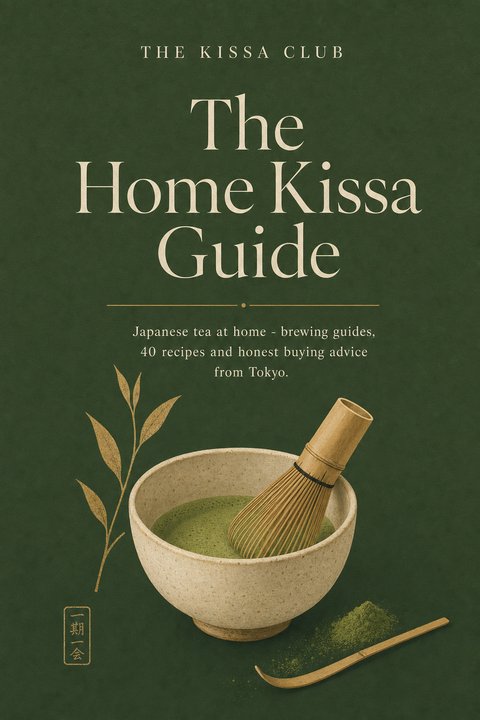
The Home Kissa Guide
Everything on this site, organized into one book: brewing guides for matcha, sencha, hojicha & genmaicha, 40 café-style recipes, printable recipe cards, and the buying cheat sheet Japanese shoppers actually use. $19, instant download.
Get the guide →Want matcha that actually tastes like Japan?
Grab the free 5-Minute Matcha Cheat Sheet — ratios, temperatures, and the 3 mistakes to avoid, on one printable page.
Send me the cheat sheet →