Buying Guides
How to Read a Japanese Tea Label (Without Reading Japanese)
The most expensive-looking word on a Japanese tea label is usually the one that means nothing. The words that tell you whether the tea is any good are small, boring, and printed on the back in a font nobody photographs.
If you’ve ever stood there holding a beautiful tin you can’t read, this is the ten-minute version of what a Japanese shopper sees.
Why the back of the package beats the front
Japanese food labeling law is strict about exactly the things marketing departments find boring: what the product is, what’s in it, how much it weighs, when to drink it by. The front of the package, meanwhile, can say almost anything it likes.
So the trick my whole country uses without thinking about it: ignore the calligraphy, flip the tin over, and find the small information box. Everything below lives there.
The type words — what kind of tea is this?
You don’t need to read Japanese. You need to recognize about eight shapes. Every one of them contains 茶 — that’s “tea,” and once you can spot it, the label starts sorting itself.
- 煎茶 (sencha) — standard steamed green tea, the default tea of Japan. If a bag says nothing else, it’s this.
- 深蒸し (fukamushi) — “deep-steamed.” Cloudier, richer, more forgiving of sloppy brewing. I’ve said it before in the sencha guide: this is the best first bag for someone coming from teabags.
- 玉露 (gyokuro) — shaded, expensive, brewed lukewarm in tiny amounts. A different hobby.
- 玉露入り (gyokuro-iri) — “with some gyokuro mixed in.” Watch for 入り; that one character means contains some, and it’s doing quiet work all over Japanese shelves.
- ほうじ茶 (hojicha) — roasted, toasty, low caffeine. Full guide here.
- 玄米茶 (genmaicha) — green tea with roasted rice. Popcorn-adjacent, cheap, wonderful.
- 抹茶 (matcha) — powdered. On a leaf-tea label, 抹茶入り means a dusting of matcha was added to make the brew greener. It’s cosmetic, not a scam, but you’re not buying matcha.
- 新茶 (shincha) / 一番茶 (ichibancha) — new tea / first harvest. The spring-festival version of the leaf. Worth money.
The words that are actually worth paying for
Three things on a Japanese label justify a higher price, and all of them are verifiable facts rather than adjectives:
A named place. 静岡 (Shizuoka), 宇治 (Uji), 八女 (Yame), 鹿児島 (Kagoshima). A grower willing to say where the leaf came from is making a claim someone could check.
A harvest word. 一番茶 or 新茶, as above. Later harvests are flatter and more astringent, and honest labels simply don’t mention harvest at all.
A short ingredient list. The 原材料名 (ingredients) line on good leaf tea says one thing: 緑茶. Tea. If you see a list, you’re holding a blend of tea and decisions.
And one personal, biased addition: 玉露入り is the best value trick in the aisle. A regular sencha with some shaded leaf folded in gets you a hint of that thick, sweet, almost broth-like depth — the taste Japanese people call mattari, a word for umami that lingers instead of finishing — for a few hundred yen more. I’ve bought the bottom-shelf bag to save money and regretted it. I have never once regretted the 玉露入り bag one shelf up.
The words that mean nothing
- 高級 (kōkyū) — “premium.” Self-awarded. No standard, no audit, no meaning.
- 銘茶 (meicha) — “famous tea.” Famous according to the person selling it.
- 特選 / 特上 (tokusen / tokujō) — “specially selected / extra-fine.” These are house-internal ranks. Useful for comparing two tins from the same maker, useless for anything else.
One that looks like a trap but isn’t: お徳用 (o-tokuyō) means “value pack.” It’s not hiding anything — it’s the honest big bag for making daily tea by the liter, which is how most tea actually gets drunk in Japan. My family’s default was exactly this: cold-brewed from a value bag, in a pitcher in the fridge, all summer. A supermarket here carries thirty or forty teas in a row, and the o-tokuyō shelf is the one that empties fastest — because brewing at home costs a fraction of anything in a bottle.
The date line
賞味期限 (shōmikigen) is the best-by date, usually printed as year.month.day — 2027.04.15 — or just year and month. Japanese order, largest unit first.
Tea doesn’t spoil, but it does fade, and green tea fades faster than almost anything else in your kitchen. A tin sitting near its date was packed a year or more ago. It’ll be safe, and it’ll be beige. (How to store it once opened.)
Eight shapes, one afternoon
That’s the whole system: find 茶, check for 深蒸し or 玉露入り, look for a place name and a harvest word, ignore the adjectives, read the date. You now shop like a Japanese grandmother, minus the ability to judge a tea shop owner by their small talk.
If somewhere in this article the Japanese stopped feeling like a wall and started feeling like a puzzle — that’s the actual on-ramp to the language. The one I point readers to is JapanesePod101, because their beginner lessons live in exactly this register of Japanese: menus, labels, asking what something is — spoken by real people rather than a textbook narrator. There’s a free lifetime account, which is enough to find out whether the language bug has actually bitten you. Fair warning from someone with an inbox: their promotional emails are relentless. Make the account, mute the promotions, keep the lessons.
The label can be learned in an afternoon. The tea takes longer, but that’s the enjoyable part.
From the Kissa Club kitchen
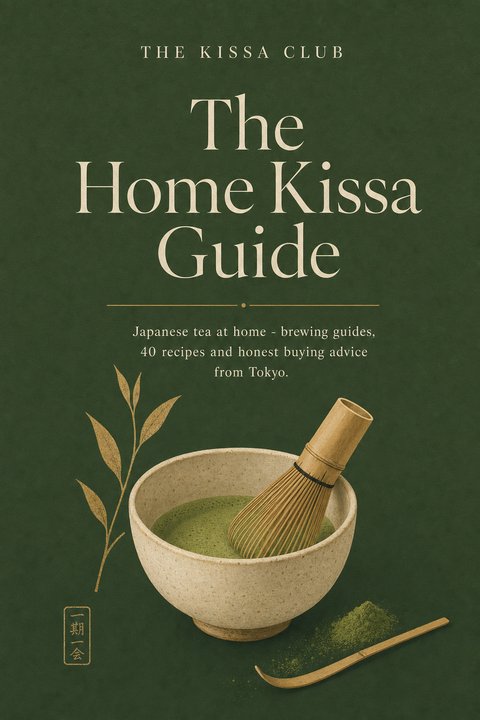
The Home Kissa Guide
Everything on this site, organized into one book: brewing guides for matcha, sencha, hojicha & genmaicha, 40 café-style recipes, printable recipe cards, and the buying cheat sheet Japanese shoppers actually use. $19, instant download.
Get the guide →Want matcha that actually tastes like Japan?
Grab the free 5-Minute Matcha Cheat Sheet — ratios, temperatures, and the 3 mistakes to avoid, on one printable page.
Send me the cheat sheet →