Japanese Tea
Genmaicha vs Hojicha vs Sencha: Japan's Everyday Teas, Compared
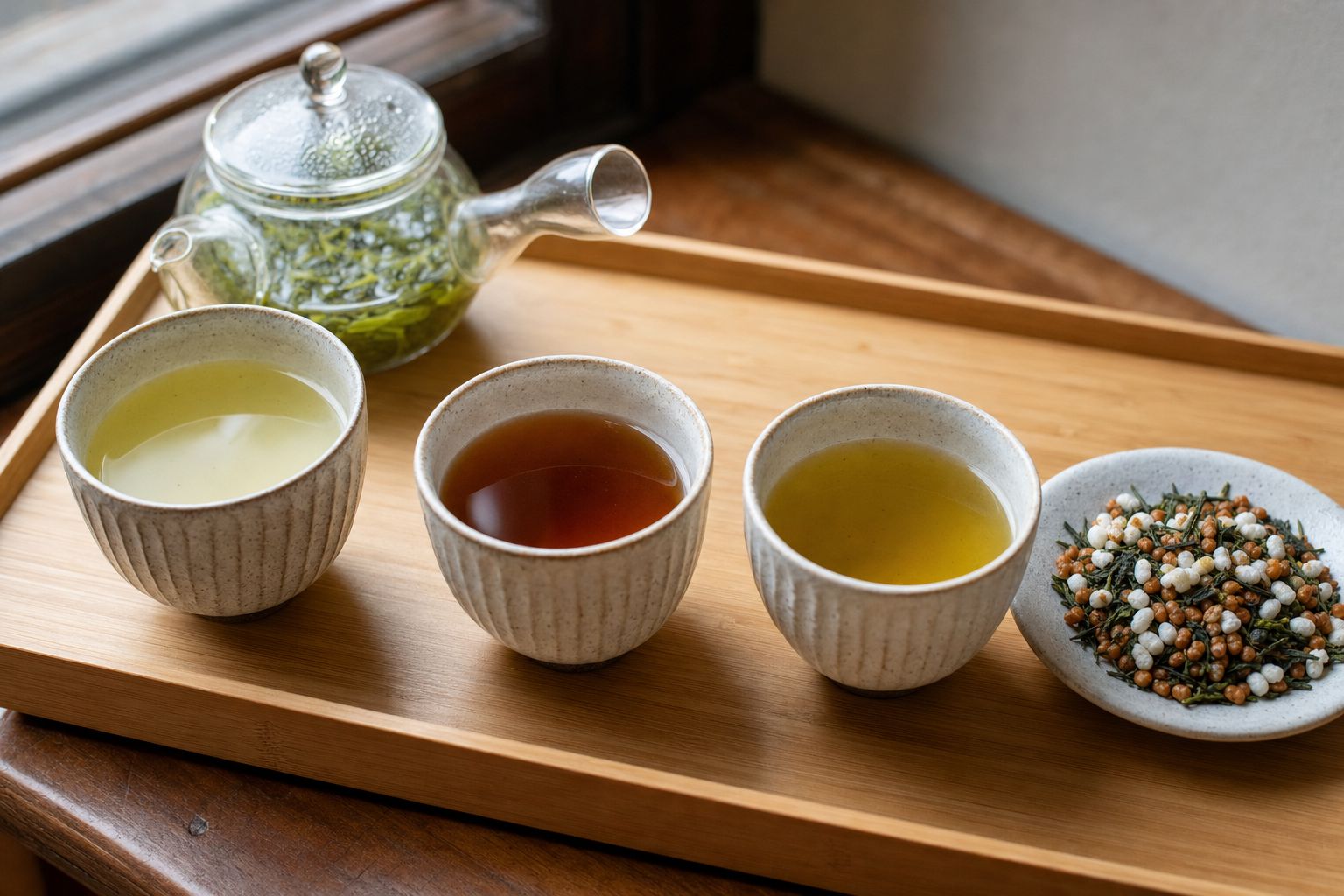
Ask someone outside Japan to name a Japanese tea and you’ll get matcha, maybe sencha if they’ve traveled. Almost nobody says genmaicha. And yet genmaicha — green tea cut with roasted rice — is one of the most ordinary teas in the country, the kind that shows up in office pots and at some sushi restaurants without anyone treating it as special.
The short answer: sencha is the daytime default, hojicha is the low-caffeine evening tea, and genmaicha is the everyday, goes-with-food tea — nutty, cheap, and the one most forgiving of a bad steep. If you only keep one tea at home and want it to survive clumsy brewing, genmaicha is the safest bet of the three.
What actually makes these three different
All three start as green tea, and the differences come down to what happens after the leaves are picked.
Sencha is steamed right after harvest and left alone. That steam stops oxidation and locks in the grassy, slightly astringent flavor that most people picture when they hear “green tea.” I’ve covered the brewing side of sencha in detail here — the short version is that it rewards precision, especially water temperature.
Hojicha takes that same leaf (often the cheaper, later-harvest bancha) and roasts it at high heat until it turns reddish-brown. Roasting burns off most of the bitterness and a good chunk of the caffeine, which is why it’s the tea Japanese households hand to kids and grandparents without a second thought.
Genmaicha does something different: it leaves the green tea itself mostly alone and instead blends it, roughly half and half, with roasted rice. Traditionally that base tea was bancha, the same workhorse leaf behind most hojicha, though plenty of brands now make genmaicha with sencha or even gyokuro folded in for a more refined version. The rice is soaked, dried, and roasted until some of the kernels pop — which is where genmaicha gets its nickname, “popcorn tea.” Crack open a bag and you’ll see pale, puffed grains sitting right alongside the leaf.
The comparison, side by side
| Sencha | Hojicha | Genmaicha | |
|---|---|---|---|
| What it is | Steamed green tea leaf | Green tea, roasted | Green tea + roasted rice (~50/50) |
| Caffeine (rough, per cup) | ~30 mg | ~10–20 mg | Roughly half of sencha — in hojicha’s range |
| Flavor | Grassy, slightly bitter, umami | Toasty, caramel, nutty | Nutty, popcorn-like, mild |
| When it’s drunk in Japan | Morning and daytime | Evening, with dinner, for kids | With meals, all day, as a budget default |
| Typical price | Mid-range | Mid-range | The cheapest of the three |
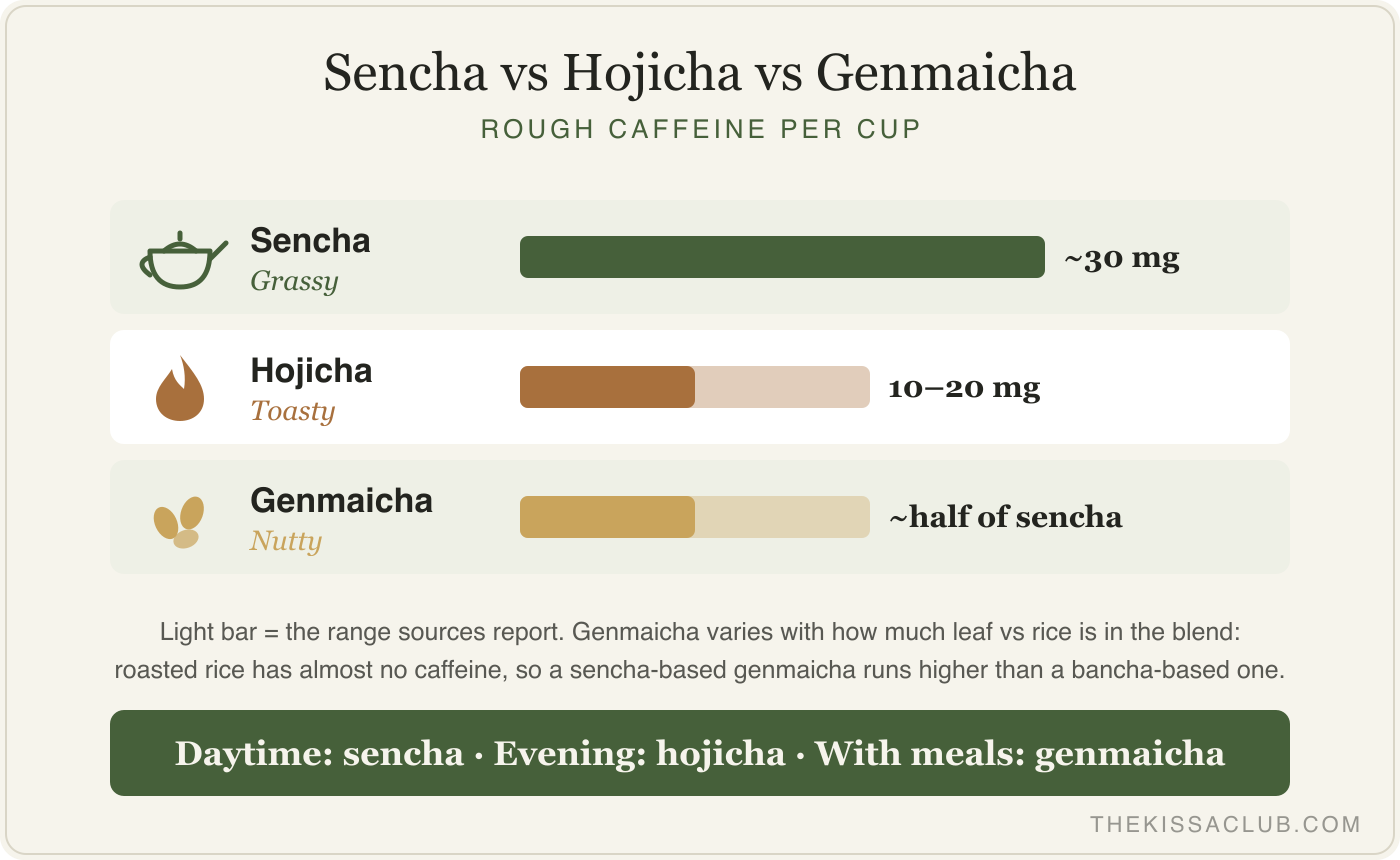
That caffeine row deserves a caveat. Sources that test genmaicha directly don’t agree with each other — estimates range from barely-there to a third of a cup of coffee, depending on how much actual leaf is in the blend versus rice. The one thing every source agrees on: roasted rice itself has almost no caffeine, so diluting the leaf with it pulls genmaicha’s number down from wherever the base tea started. A genmaicha made with sencha will run higher than one made with bancha or hojicha, for the same reason a weaker pour of coffee has less caffeine than a strong one.
Where this actually shows up in my life
I drink genmaicha at least once a month, usually without planning to — it’s the tea that gets put in front of you rather than the one you go looking for. Some sushi restaurants pour it instead of the usual green tea, and it’s a common free pour at Japanese drugstores, which keep a hot water and tea dispenser near the registers for anyone waiting around. You press a button, out comes genmaicha or plain green tea, and it’s genuinely fine — not a consolation prize, just tea.
The appeal for me isn’t really the caffeine math. It’s the rice. Genmaicha carries a toasted, almost savory note that makes it feel like it belongs next to food rather than instead of a snack, and the “brown rice is healthy” association — accurate or not — makes it an easy tea to reach for without thinking too hard about it.
My own loyalty, if I’m honest, is to a specific regional tea rather than genmaicha as a category: 足柄茶 (Ashigara tea), grown in the Hakone and Tanzawa foothills of Kanagawa Prefecture. It’s not a genmaicha blend at all, just a straight leaf tea, but it’s the one I’ll pick off a shelf by name the way some people look for a specific coffee roaster. Ashigara tea has been grown in that area since the 1920s, originally planted as a post-earthquake reconstruction crop, and it’s stayed a quietly respected regional tea rather than a famous export name like Uji or Shizuoka.
How to brew it (the part that needs almost no technique)
- Leaves: about 3 g of the genmaicha blend per 200 ml of water — a slightly heaped teaspoon, since roasted rice is light and takes up volume
- Water: hot, close to boiling. Unlike sencha, there’s little bitterness left to protect against, so you don’t need to cool the water
- Time: 30–45 seconds for the first steep
- Resteep: genmaicha gives a second cup, though the rice flavor fades faster than the leaf does, so steep two will taste thinner and greener
That’s really it. There’s no 70-degree rule to remember here, no timer anxiety. If sencha is the tea that punishes a distracted brewer, genmaicha is the one that barely notices.
Buying genmaicha worth drinking
Look at the ratio before the brand name. A bag heavy on rice and light on leaf will taste like toasted grain with a faint tea aftertaste — fine for some people, but not what you’re paying tea prices for. A visible, roughly even mix of leaf and puffed kernels is the sign of a normal, well-made blend.
One opinion I’ll state plainly: don’t pay extra for the “deluxe” genmaicha dusted with matcha powder. It does make the brewed cup greener and slightly rounder-tasting, but not enough to justify the markup over a well-made plain blend — a small amount of matcha dust is doing a decorative job more than a transformative one, the same light touch as matcha-dusted sencha on the label.
And one honest downside: genmaicha goes stale faster than you’d expect, because roasted rice loses its toasted aroma well before the leaf does. A bag that’s been open for a few months will still be safe to drink — it just stops smelling like anything in particular. Buy smaller bags more often rather than one large tin you’ll be finishing in June.
Which one, and when
None of these three teas is “better.” They’re doing different jobs. Sencha is for mornings when you want the real green-tea flavor and don’t mind a little bitterness if you oversteep. Hojicha is for the hours when you still want a warm cup but need caffeine out of the equation. Genmaicha is the one you keep around for everything in between — a tea that sits next to a meal without competing with it, forgiving enough that you can pour it, get distracted, and come back to a cup that still tastes fine.
There’s a word for that kind of unglamorous good tea: 和み (nagomi), a gentle settling or easing, as opposed to anything exciting. Genmaicha isn’t trying to impress you. It’s trying to be there the next hundred times you’re thirsty, which is a harder job than it sounds.
If you’ve only ever had one of these three, start with whichever one you’re missing — and if your cupboard is like mine, the rice-scented bag is the one that actually runs out first.
From the Kissa Club kitchen
The Home Kissa Guide
Everything on this site, organized into one book: brewing guides for matcha, sencha, hojicha & genmaicha, 40 café-style recipes, printable recipe cards, and the buying cheat sheet Japanese shoppers actually use. $19, instant download.
Get the guide →Want matcha that actually tastes like Japan?
Grab the free 5-Minute Matcha Cheat Sheet — ratios, temperatures, and the 3 mistakes to avoid, on one printable page.
Send me the cheat sheet →