Matcha Basics
The Japanese Words on a Matcha Package That Don't Mean What You Think
In Japan, the word “ceremonial” does not appear on matcha. Walk every tea aisle in Tokyo and you will not find it once. The words that do appear are stranger, older, and far more useful — and because exporters rarely translate them, the most informative text on the package is usually the part you can’t read.
We’ve already covered why “ceremonial grade” is a marketing invention. This is the other half: what the Japanese on the tin is actually telling you.
入り (-iri): “contains some”
The single most load-bearing character in Japanese food marketing is 入り, pronounced iri. It means “with ~ in it,” and it is doing enormous, quiet work.
抹茶入り on a latte mix, a chocolate, a soft-serve sign, a bag of cheaper green tea — all of it means some matcha was involved. How much? The label doesn’t say, and legally doesn’t have to. Its cousin 抹茶使用 (“uses matcha”) is the same move in a different suit.
My own matcha career started exactly there, and I’m not sorry about it. First school trip to Kyoto: matcha ice cream, matcha pudding, matcha yatsuhashi sweets, two days straight. Every one of those was an 入り product. They’re honest desserts and some are excellent — the convenience-store matcha sweets here would embarrass mid-range cafés abroad. Just know that none of them tell you anything about what’s inside a tin of actual powder.
宇治 (Uji): a method more than an address
Here’s the one that surprises people. “Uji matcha” does not legally require the leaf to be grown in Uji, the small city south of Kyoto. Under the tea industry’s own definition, tea grown in Kyoto and the neighboring prefectures of Nara, Shiga and Mie, processed in Kyoto by Uji-style methods, may be sold as Uji-cha.
That isn’t a scandal — it’s how most traditional food appellations actually work, and the processing style is genuinely the point. But it does mean 宇治 on a package is a claim about how, not a GPS coordinate. If a producer names an actual farm or town, that’s the stronger signal, same as ever.
薄茶 and 濃茶: the real grading system is a serving suggestion
Japanese matcha isn’t graded “ceremonial vs culinary.” It’s described by what you’re meant to do with it: 薄茶 (usucha, “thin tea” — the everyday whisked bowl) and 濃茶 (koicha, “thick tea” — nearly a paste, the intense preparation from formal tea gatherings).
This is the quiet genius of the system: koicha is the stress test. A matcha labeled 濃茶用 or お濃茶に (suitable for thick tea) is claiming it stays sweet and smooth at triple strength, where any harshness would be unbearable. That claim is the closest thing to “top grade” that exists in Japanese.
I understood this viscerally exactly once, at a tea counter in Ginza where a single cup costs what a lunch course does. Prepared thick, a proper koicha-grade matcha doesn’t taste “strong” — it goes round and deep, that lingering savory sweetness Japanese calls mattari, closer to a wine tasting than to anything I’d call a beverage. You don’t need to spend that money. But once you know the top of the scale exists, 濃茶用 on a label stops being decoration.
石臼挽き (ishiusu-biki): stone-milled, slowly
This one means what it says — granite mills, turning slowly, producing roughly 40 grams an hour. Real stone milling gives the powder its 5-micron fineness and keeps it cool, which protects aroma. It’s a meaningful phrase, with one caveat: like “harvest,” the honest tins tend to be specific (mill speed, batch dates) and the vague ones just print the kanji.
点てる (tateru): you don’t “make” matcha
Small vocabulary pleasure, no purchase implications: Japanese has a dedicated verb for preparing matcha. Not brew, not mix — 点てる, tateru, the same character as “lighting” a fire. You’ll see 点て方 (“how to whisk”) printed on the back of nearly every tin, usually with the ratio we walk through in the at-home guide.
有機 (yūki): the one word that IS regulated
After all these unregulated terms, one exception deserves its flowers: 有機 (organic) with the round green JAS mark is a real, audited, government-backed certification. Whatever you think of organic as a taste proposition — shading and harvest matter more to flavor, in my biased opinion — the mark itself is the only word on the front of the tin that someone can lose a license over misusing.
The honest tin, summarized
Reading a matcha package like a Japanese buyer comes down to this: skip the adjectives, look for 一番茶 (first harvest), a specific place, a date, and — if you want the strongest quality claim the language offers — 濃茶 somewhere on the label. Treat 入り products as dessert, not data. Respect the JAS mark. Everything else is font choice.
You can learn to recognize these eight characters in an afternoon; if the afternoon turns into actually wanting the language, JapanesePod101 is the resource I recommend to readers — real spoken Japanese, a beginner path built around reading and ordering rather than exam prep, and a free account to test the water before spending anything.
The tin was never trying to fool you. It just assumed you could read it — and now, mostly, you can.
From the Kissa Club kitchen
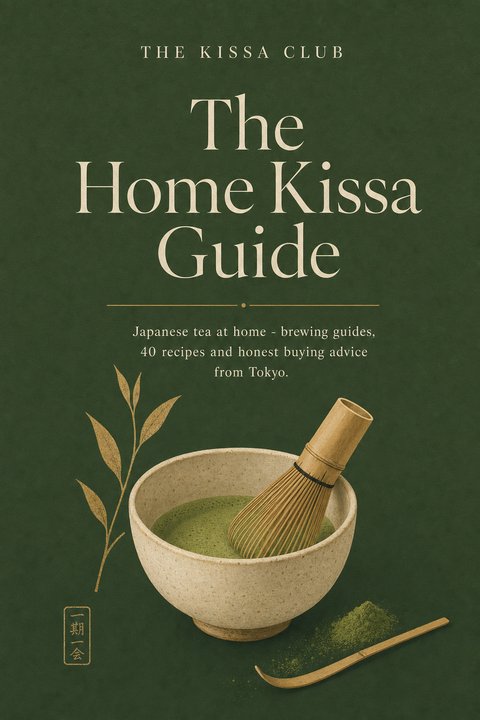
The Home Kissa Guide
Everything on this site, organized into one book: brewing guides for matcha, sencha, hojicha & genmaicha, 40 café-style recipes, printable recipe cards, and the buying cheat sheet Japanese shoppers actually use. $19, instant download.
Get the guide →Want matcha that actually tastes like Japan?
Grab the free 5-Minute Matcha Cheat Sheet — ratios, temperatures, and the 3 mistakes to avoid, on one printable page.
Send me the cheat sheet →