Japanese Tea
Genmaicha: The Japanese Tea Everyone Drinks Without Trying To
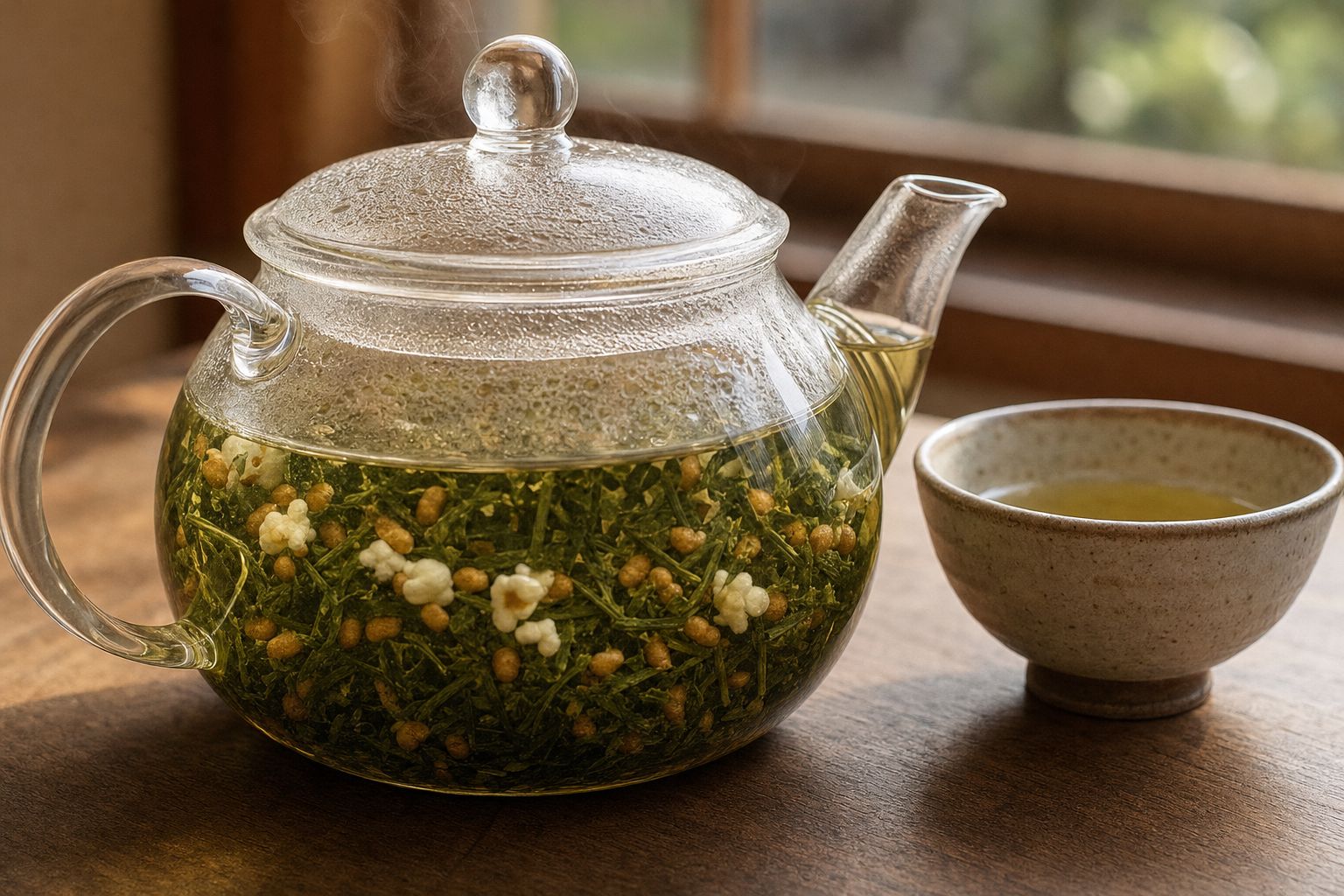
Nobody in Japan plans a trip around genmaicha. It’s not a souvenir tea, not a gift-box tea, not the thing a tea shop puts in the window. It’s the tea that’s just there — in the pot at a cheap diner, in the dispenser at a pharmacy, in the box your coworker keeps in the break room because it was on sale. I’d guess most people who drink it regularly couldn’t tell you the last time they chose it on purpose.
That’s actually the most honest way to describe genmaicha: it’s the green tea Japan reaches for by accident, constantly. I’m a slight exception — I actually like it, and I drink it at least once a month on purpose.
What’s actually in the bag
Genmaicha is green tea — usually the everyday leaf called bancha, sometimes a step up to sencha — blended roughly half and half with roasted brown rice. The rice gets soaked, dried, and roasted until some kernels pop open, which is where the tea picked up its unofficial English nickname, “popcorn tea.” Crack a bag open and you’ll see pale, puffed grains sitting right next to the dark leaf.
I’ve already covered the flavor and caffeine mechanics against hojicha and sencha in more detail elsewhere, so I won’t re-run that comparison here. The short version, if you’re new to it: the rice dilutes the leaf, so you get a nutty, mild cup with noticeably less caffeine than straight sencha, and almost no bitterness to manage. It’s a tea built to be hard to mess up.
Nobody actually knows where it came from
I looked into the history expecting a clean answer and didn’t find one, so I’ll say that plainly rather than picking the best-sounding story and presenting it as fact.
One version says it goes back to the Edo period, when sellers stretched expensive tea leaves with roasted rice to make it affordable for ordinary households. Japanese tea companies more often tell a different story: a Kyoto tea merchant in the early Showa era supposedly roasted leftover pieces of mochi from a New Year’s kagami-biraki ceremony and mixed the crumbs into his tea rather than waste them. There’s also a samurai-era legend about a servant named Genmai who dropped rice into his master’s cup — fun, but treated by pretty much every source as folklore rather than history.
What all the versions agree on is the economics: rice was cheap, tea leaf was not, and blending the two let poorer households drink something that tasted like tea without paying full price for it. Genmaicha has stayed a value tea ever since, even now that nobody actually needs the discount.
The sushi-tea myth, cleared up
Here’s one I’ll correct, because I used to half-believe it myself: genmaicha is not the tea traditionally served at sushi counters in Japan. That tea is called agari, and in a real sushi-ya it’s almost always konacha — the dusty, bitter leftover bits from processing higher-grade tea, served free because it’s cheap and because its bitterness cuts through fish oil. Genmaicha shows up as the “sushi tea” mostly at sushi restaurants outside Japan, where it’s an easier sell than a tea made from literal tea-processing scraps.
So if a restaurant menu abroad describes genmaicha as “the traditional tea served with sushi in Japan,” that’s marketing smoothing over a detail, not a mistranslation worth getting worked up over.
Where I actually drink it
I like the taste — that toasted-rice note is the whole appeal for me — and I’ll admit the brown rice gives it a vaguely healthy image in my head too. It sits in a rotation with green tea, hojicha, and Ashigara tea from Kanagawa, which is what I drink most at work. But a lot of my genmaicha isn’t chosen at all; it finds me.
The clearest example: free tea dispensers. Everyone assumes drugstores have these, and some do, but in my experience you’re more likely to find one at a dispensing pharmacy — the kind attached to a clinic, like a Nihon Chouzai branch — than at a general drugstore. Kids waiting for a prescription love pressing the button. I’ll be honest about the tea itself, though: it’s not particularly good. Thin, a little flat, clearly made for volume rather than flavor. I drink it anyway, because it’s there and it’s warm and waiting rooms are boring.
That’s genmaicha’s public personality, really. It’s rarely the tea anyone names as their favorite, even people like me who quietly enjoy it. It’s just there, constantly, everywhere.
Buying a bag that isn’t just rice
If you’re shopping for genmaicha rather than drinking whatever’s handed to you, a few things actually matter:
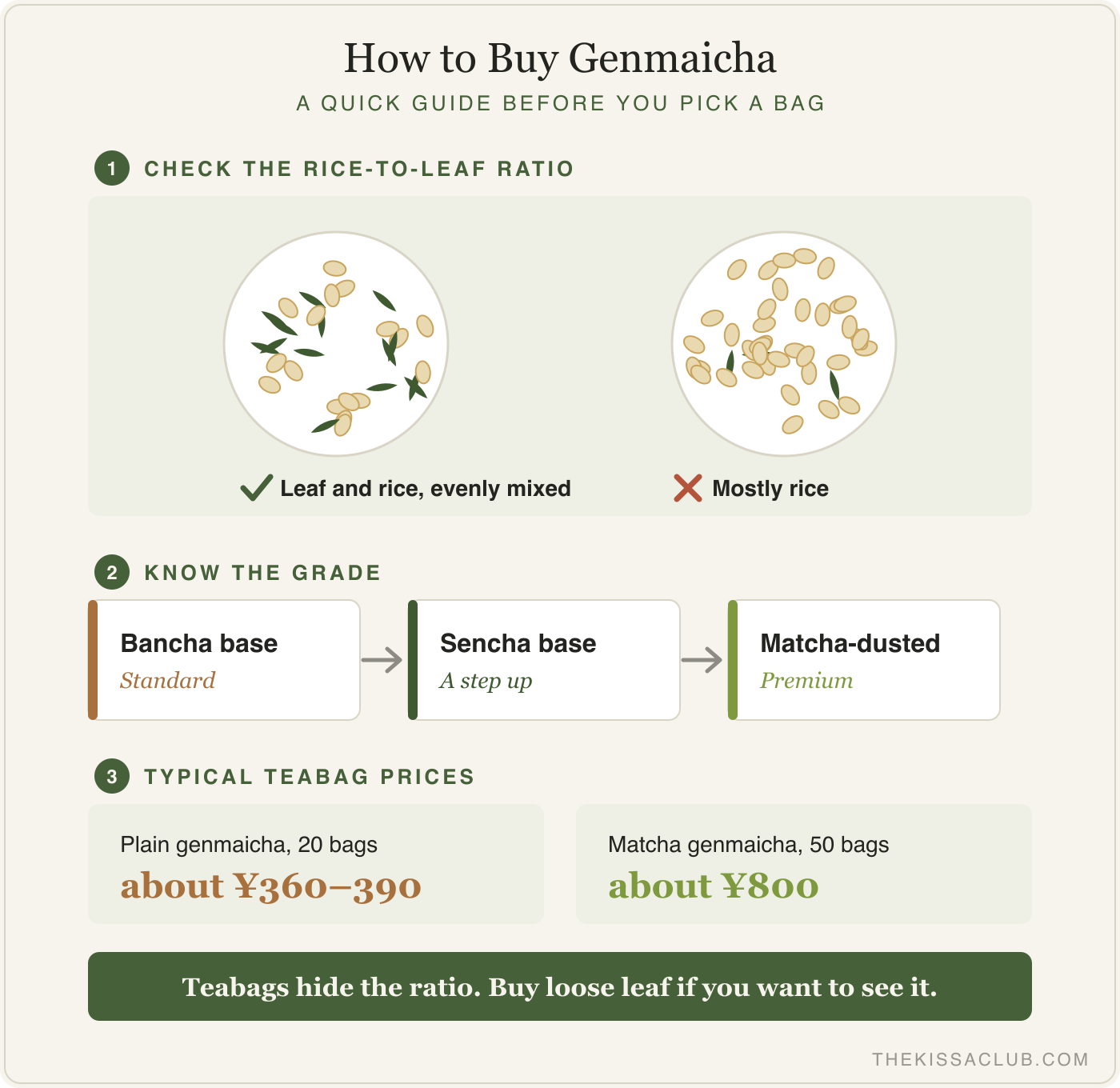
- Check the rice-to-leaf ratio by eye. Open loose-leaf genmaicha before buying if you can. A bag that’s mostly puffed rice kernels with a few scattered leaves will taste like toasted grain water. You want visible dark tea leaf mixed evenly with the rice, not rice with tea leaf as a garnish
- Bancha-based is standard; sencha or gyokuro-based is the “nicer” version. Brands that use a higher tea grade in the blend will usually say so on the package — this is the one place I’d actually read the kanji on the bag rather than trusting a cute English sticker
- Matcha-dusted genmaicha is a real category, rather than a gimmick label. Ito En’s “Oh! Ocha” premium line, for example, sells a Uji-matcha genmaicha teabag box (2.3g × 50 bags) that’s typically listed around ¥800. Their plain genmaicha teabags (20 bags) run closer to ¥360–390. Neither is expensive; this is still a value tea at heart
- Tea bags hide the ratio. That ¥360 box is fine for an office drawer, but you’re trusting the manufacturer on blend quality since you can’t see inside each bag before brewing
One opinion, stated plainly: don’t go looking for an “artisan” or single-origin genmaicha at a markup. The entire reason this tea exists is to stretch a smaller amount of good leaf further. Paying premium prices for a tea whose whole design brief is cheap and forgiving misses the point of what you’re buying.
How to brew it without thinking too hard
- Leaves: about 3g per 200ml of water — a slightly heaped teaspoon, since the puffed rice takes up more room than it weighs
- Water: hot, close to boiling. There’s little bitterness here to protect against by cooling the water down
- Time: 30–45 seconds for the first steep
- Food pairing: this is the tea to drink alongside something greasy or heavy — fried food, a bento, konbini fried chicken. The roasted-rice flavor sits underneath the food instead of fighting it, which is a big part of why it ended up in diners and lunch counters in the first place
There’s a Japanese word for the kind of thing genmaicha is: nantonaku (なんとなく) — doing or choosing something for no particular reason, without really deciding to. Nobody wakes up craving genmaicha. You just end up drinking it, nantonaku, and most of the time that’s completely fine.
The honest verdict
Genmaicha isn’t a tea worth chasing down at premium prices. If you want complexity, buy a good sencha instead. But if you like toasty, nutty flavors the way I do, or you want a cheap, low-caffeine, nearly unkillable everyday tea to keep in the cupboard for the days you can’t be bothered to care — this is the one Japan has been quietly relying on for exactly that job, probably longer than anyone can actually prove.
From the Kissa Club kitchen
The Home Kissa Guide
Everything on this site, organized into one book: brewing guides for matcha, sencha, hojicha & genmaicha, 40 café-style recipes, printable recipe cards, and the buying cheat sheet Japanese shoppers actually use. $19, instant download.
Get the guide →Want matcha that actually tastes like Japan?
Grab the free 5-Minute Matcha Cheat Sheet — ratios, temperatures, and the 3 mistakes to avoid, on one printable page.
Send me the cheat sheet →