Matcha Basics
Matcha Starter Kit: Everything You Need for Under $50
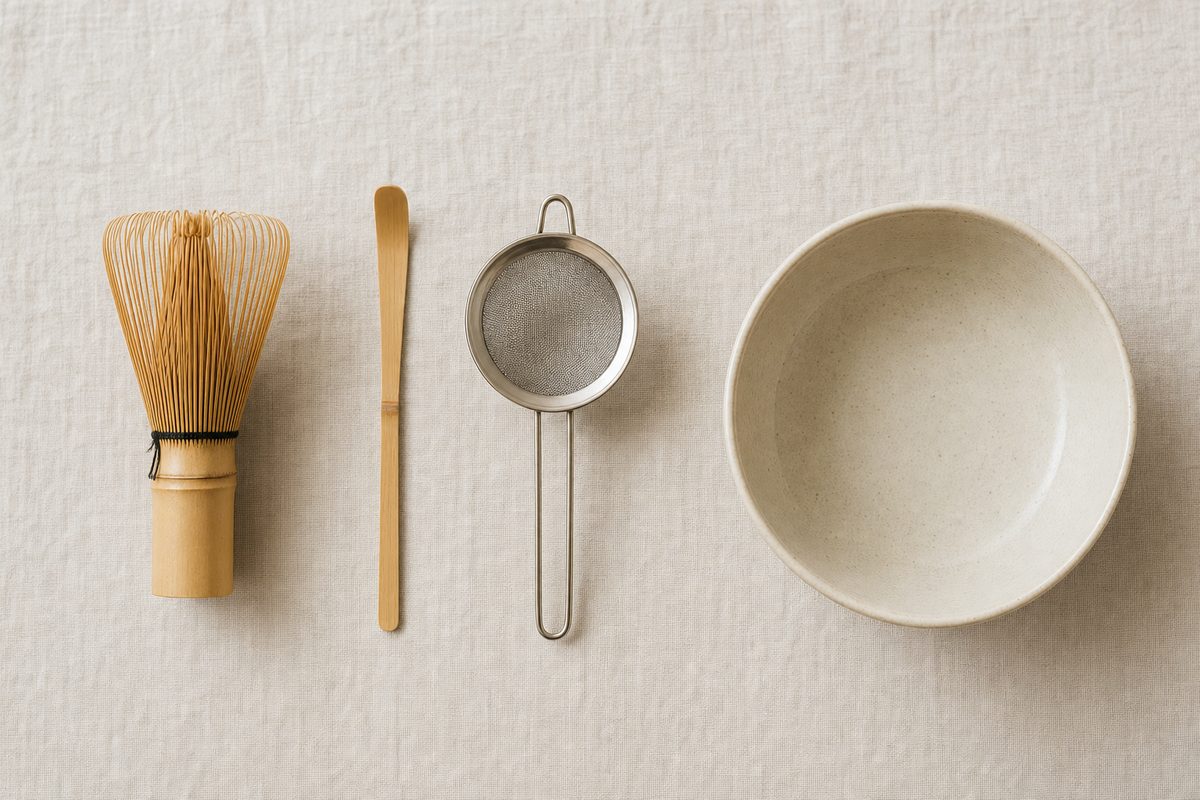
The $200 “complete tea ceremony set” with fourteen pieces? Nobody in Japan owns that. I want to say this early, because the matcha-gear industry abroad has convinced a lot of beginners that the entry fee is high. It isn’t.
The real list is four items, and you can cover it for $35–50: a bamboo whisk (chasen), any wide bowl you already like, a small sifter, and a whisk stand if you want the whisk to live long. That’s the whole kit. Here’s what each one does, what it costs, and what you genuinely don’t need yet.
And if you’re not sure yet that you even like matcha — maybe the one time you tried it, it was bitter — buy nothing today. Our how to make matcha guide includes a jar-and-strainer method that uses zero special equipment. Make three bowls that way first. The kit below is for the week you catch yourself wanting a fourth.
The four that matter
1. Chasen (bamboo whisk) — $12–20
The one tool with no good substitute. Eighty-or-so fine bamboo tines aerate matcha into foam in a way no fork, spoon, or electric frother fully replicates for straight matcha.
What to buy: a standard 80-tine (yaho or kazuho style) whisk. White bamboo and dark bamboo work the same; the difference is tradition, not function. Jade Leaf’s whisk-and-scoop pair runs about $15 and is the unremarkable, correct version of this — which is exactly what you want, since you’ll replace it.
What to skip: “artisan” whisks over $40. They exist, they’re beautiful, and a beginner cannot taste the difference. The honest truth is that a chasen is a consumable — with daily use, tines start breaking within a year no matter what you paid.
Worth knowing: even in Japan, a chasen is not a default household item. My grandparents — serious tea drinkers who brewed loose-leaf sencha in a kyusu every single day — never owned one. Whisked matcha was something you encountered at a temple, a tea shop, or a school event, not at the kitchen table. So if buying a bamboo whisk feels like a small commitment, you’re in good company: it’s a small commitment for most Japanese households too. That’s part of why it feels special.
2. A bowl — $0 (yes, zero)
A chawan is lovely. It is also, functionally, a wide bowl. In Japanese homes that drink casual matcha, plenty of people use a cereal bowl or a large café au lait bowl, and the tea doesn’t know.
The requirements: wider than a mug (your whisk needs room for the W-motion), and holding at least 300 ml comfortably. If it’s in your cupboard, your kit just got $25 cheaper.
When to upgrade: when you notice the ritual has stuck. A real chawan — heavy, warm in both hands — genuinely does change how the morning feels. It’s just not a day-one purchase. When that day comes, a plain bowl with a pour spout (around $19) is more practical than a beautiful one, because most of what you make will end up in a glass with milk anyway.
3. A small fine-mesh sifter — $5–8
Unglamorous. More important than the bowl. Matcha clumps from static electricity, and thirty seconds of sifting is the difference between silk and little bitter surprises. Any small tea strainer works; dedicated matcha sifters (furui) are nicer but optional — Jade Leaf’s is about $10, which is roughly what a kitchen-shop strainer costs anyway. Don’t overthink this one.
4. Whisk stand (kusenaoshi) — $8–12
A ceramic bulb the whisk rests on so its curved tines dry in shape instead of splaying. Not strictly required — but it roughly doubles the life of the item most likely to wear out, which makes it the best value purchase on this page. The standard ceramic one is about $15 — a little more than I’d like for what it is, but still cheaper than the second whisk it saves you from buying.
What you don’t need (yet, or ever)
- Chashaku (bamboo scoop): a teaspoon measures 2 g just fine. Buy the bamboo one when you want it, not because a listicle said so.
- Electric frother: actually useful — for lattes. For straight matcha it makes coarse, short-lived foam. It belongs in our iced matcha latte recipe setup, not here.
- A thermometer: useful, skippable. The pour-and-wait trick (boiling water into an empty cup, wait a minute) lands you close enough to 80°C.
- Matching “ceremony sets”: you’re building a morning habit, not performing a formal chaji. The fourteen-piece set is décor.
The $50 shopping list, summarized
| Item | Price | Skippable? |
|---|---|---|
| 80-tine chasen | $12–20 | No |
| Wide bowl from your cupboard | $0 | — |
| Fine-mesh sifter | $5–10 | No |
| Whisk stand | $8–15 | Half the people skip it; I wouldn’t |
| 30g tin of decent matcha | $15–30 | The point of it all |
Total: $40–75 including your first real tin of matcha — see best matcha powder for which tin. The tools alone land under $50 even at the top of every range, which is the promise in the title and the only number I’d defend.
Start smaller than you think
There’s a Japanese instinct — you see it in kitchens, in stationery, in tools — to start with one good basic thing and let the collection grow only if the habit earns it. It’s the opposite of the fourteen-piece set.
One whisk, one sifter, one bowl you already own, one small tin. If a month from now the whisk is still wet most mornings, congratulations: now you’re allowed to browse chawan. That part is dangerous for the wallet in a way no starter kit ever is.
From the Kissa Club kitchen
The Home Kissa Guide
Everything on this site, organized into one book: brewing guides for matcha, sencha, hojicha & genmaicha, 40 café-style recipes, printable recipe cards, and the buying cheat sheet Japanese shoppers actually use. $19, instant download.
Get the guide →Want matcha that actually tastes like Japan?
Grab the free 5-Minute Matcha Cheat Sheet — ratios, temperatures, and the 3 mistakes to avoid, on one printable page.
Send me the cheat sheet →