Buying Guides
Where to Buy Matcha in Japan (and 3 Tins You Should Skip)
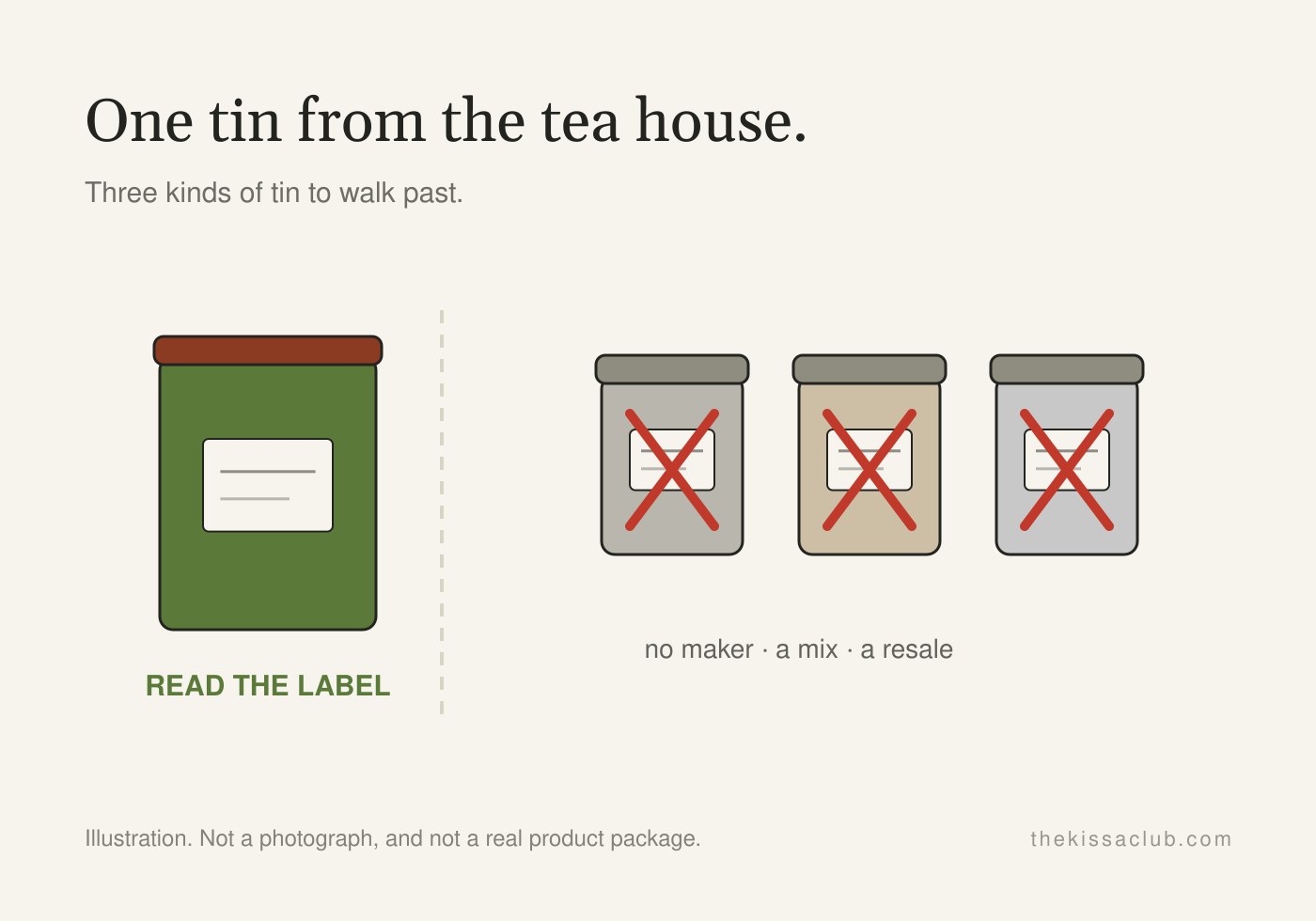
The picture above is an illustration. It is not a photo, and it is not a tin from my kitchen.
Short answer: buy matcha from the tea house’s own shop or its own website, pick one small tin for how you’ll drink it, and read the label before the price. That is the whole rule. Skip three kinds of tin: one with no maker or origin, a sweetened mix sold as pure matcha, and a resale. Expect limits and empty shelves right now. A small tin you finish within about a month of opening beats a bigger one that goes flat.
I don’t whisk matcha at home. My everyday tea is green tea. This guide is built from the shops’ own pages, checked November 19, 2026, plus what I can see from living in Japan.
The souvenir tin is the easy wrong turn
Picture Emily. She is about to land in Tokyo for eight days, with half a day in Kyoto. She can’t read Japanese. She once paid $9 for a “ceremonial” tin online, found it bitter, and decided she doesn’t like matcha. Now she is standing in front of a shelf with 45 minutes to spend, and a word in English on the lid feels like a safe place to put her trust.
I get the pull. My own first matcha memory is a school trip to Kyoto: soft-serve, pudding, and yatsuhashi sweets. It was not a tin of powder, and I did not buy powder on that trip. The memory is why matcha feels like something you pick up on the way out of a trip, in whatever shop is closest.
A tin picked that way is the easy wrong turn. “Ceremonial” is an English sales word. It is not a Japanese legal grade, and it tells you nothing about who made the powder.
Which part worries you more: reading the tin, or finding the right shop?
A mix, or a stale can, feels like “Japan was a letdown”
There are two ways this goes badly, and both end with the sentence “Japanese matcha was disappointing.”
The first is a mix. Some cheap tins are matcha with sugar or milk powder. Sold next to pure matcha, they look the same on a shelf. If you whisk one expecting tea, the result is sweet and flat, and you blame matcha.
The second is a powder that was fine once and then sat open. Matcha is ground leaf, so every gram is exposed as soon as you open it. Our storage guide works on about 4–6 weeks for an opened tin, and the maker’s own date on the label is the one to trust over mine.
Neither is dramatic. Both are avoidable at the counter.
Next: where to stand, so the label you read is a real one.
The one rule: buy from the tea house
Buy from the people who make or blend the tea: their own shop, their counter in a department store, or their own website. That is the center of this guide, and it works in any city.
Why it holds up: a maker’s shop lets you check the name, the grade, the origin line and the date against what the maker publishes. A reseller adds a markup and removes the context. Some makers say this plainly. Marukyu Koyamaen’s notice dated June 26, 2026 says it declines resale orders, and it lists its own directly run shops (Marukyu notice). It also keeps a list of unauthorized sellers. The list’s page shows an update date of November 18, 2026 (Marukyu list).
One example I can point to, because Ippodo’s own page lists it (checked November 19, 2026): Ippodo’s Shin-Marunouchi shop, about a two-minute walk underground from the Marunouchi North exit of Tokyo Station. The page gives hours of 11:00–21:00, and 11:00–20:00 on Sundays and public holidays, closed January 1 (Ippodo Shin-Marunouchi). Check the page again before you go, because hours change around holidays.
That is one shop, not a map of Japan. I haven’t been to it, and I haven’t been to any tea house in Uji either. My wife’s family home is in Tango, not far from Kyoto, and I still haven’t walked into a matcha shop there. So treat this section as the maker’s page plus a rule, not a trip report.
One more honest note. Living in Japan, I see few people around me drinking matcha itself. Some order a café matcha latte, but plain matcha is rare, as I see it. That is one person’s view, not a count. It is also why I’d rather send you to the maker’s page than to a crowd.
Official shop, department-store counter, or the official site
Three places count:
- The maker’s own shop. Check the shop’s page for hours, and for notices about stock.
- The maker’s counter in a department store. Some tea houses have one, and it is the same maker behind it.
- The maker’s official website. Domestic and overseas sites are separate shops with separate stock, prices and shipping rules. Use the one that ships where you live.
Hotels sometimes accept deliveries for guests, but only follow that route if the maker’s page says so.
Do you have a half-day or 45 minutes? With 45 minutes, one maker’s counter near your station beats a bus across town.
How to choose the tin in your hand
Five checks, in this order:
- How will you drink it? Whisked in water (usucha) or into milk? A tin sold for lattes and a tin sold for plain tea are different products.
- What does the name say? 抹茶 means matcha. 粉末茶 means powdered tea. 抹茶入り means “contains matcha,” which is a mix with other ingredients.
- Where was the leaf grown? Look for 原料原産地名. A maker you can name and an origin you can read are the two things the “ceremonial” word cannot give you.
- What is the best-before date? 賞味期限 is the unopened date. After opening, the clock is much shorter.
- Can you finish it? A small tin you’ll use in about a month is the right size for a first buy.
The line-by-line version is in how to read a Japanese tea label, and the words on the front are in matcha package words. On “ceremonial”: it is not a legal grade in Japan. The longer story is in ceremonial vs culinary matcha.
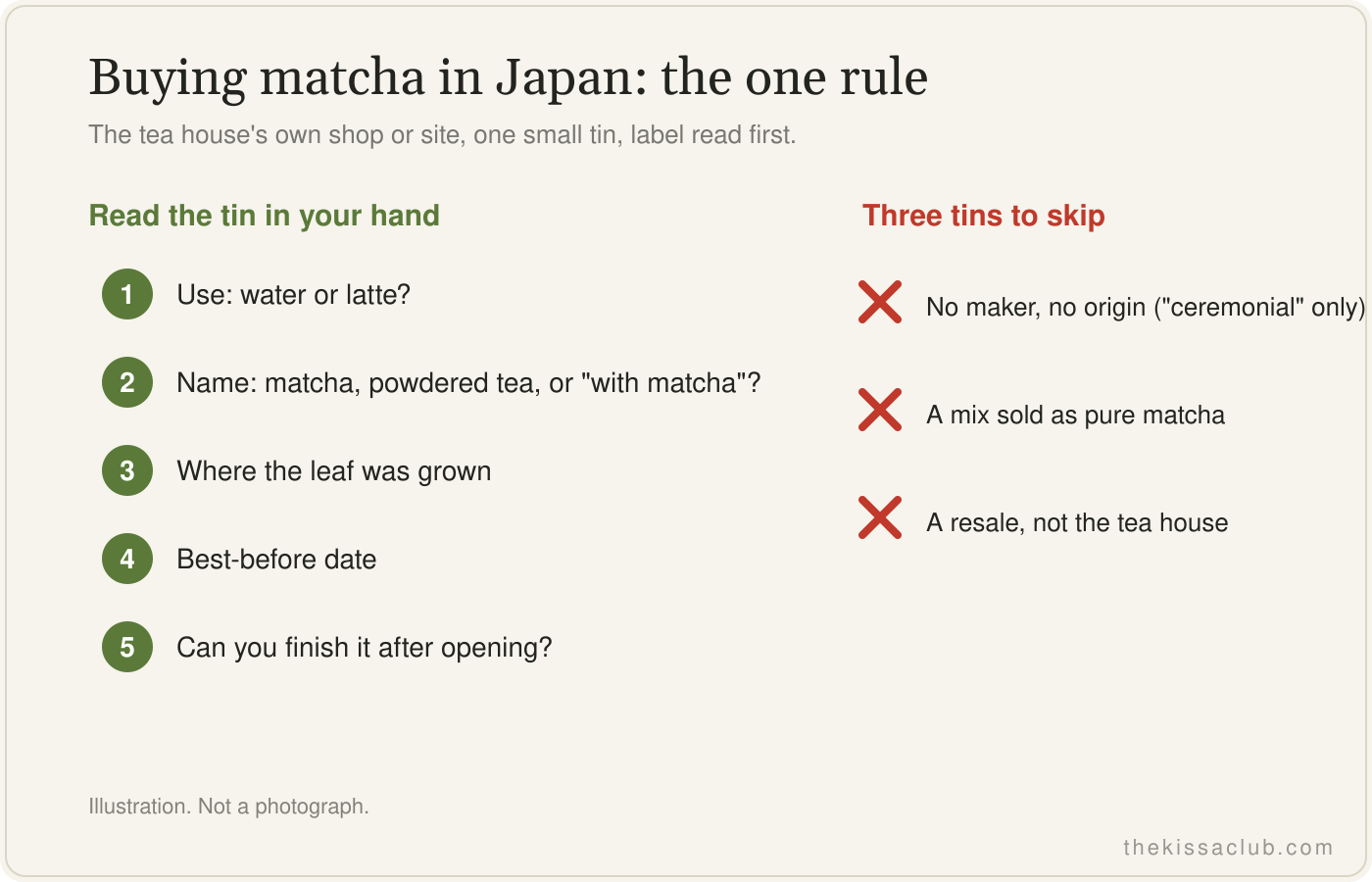
The chart is a summary of the list above. It is not a photo of a shelf.
Which of the five do you think you’d skip if you were in a hurry?
What supermarket and Don Quijote shelves actually hold
Cheap shelves tend to hold the cheapest kind of matcha product: latte mixes, sweetened powders, and baking blends. Those are useful things. They are just not the same product as a tin from a tea house.
On Ippodo’s domestic site, a 150g Uji Shimizu powder is listed at ¥648 and is sugared (Ippodo matcha collection). Set it next to a 20g tin of plain matcha and the lower price tells you nothing, because the contents are not the same. Compare by what is inside the tin, not by the price tag.
I haven’t looked at a matcha shelf in a Japanese supermarket or in a Don Quijote, so I won’t describe one. The only thing I’d say from my own life is that supermarkets here carry dozens of kinds of tea. Whether a given store has a powder shelf, I can’t tell you.
Next: what to do when the tin you wanted isn’t there.
If the shelf is empty, or you’re limited to one
Limits and sell-outs are the normal condition now. Ippodo posted a purchase-limit notice on October 8, 2024, and says the number per person is something to ask at the counter (Ippodo notice). Its overseas site says some items are limited to 10 per order and that the figure can change with stock. Don’t plan around a number someone else posted.
I see the sell-out side from my desk: online shops show “sold out” on popular tins. As for lines outside shops, I haven’t seen them, and I’m not going to describe a queue I haven’t stood in. Why it happens is covered in why is matcha sold out.
If the limit is one, take one. A bigger bag is not the goal of this trip. Whether a larger size is cheaper per gram is a separate sum, and is bulk matcha worth it does it.
Where else could you look if the counter is empty? The same maker’s website, once you’re home.
Is it cheaper to buy matcha in Japan?
I won’t give you a percentage. A percentage needs the same tin, the same size, and the same day on both sides, and that is rare.
Here is the one pair I can show from the maker’s own pages, checked November 19, 2026. Ippodo’s Ikuyo, 20g: ¥1,512 on the Japanese page, and $17 on the U.S. store. The U.S. store’s shipping page says shipping is free over $39 and ships from a U.S. warehouse.
I’m not turning that into a “cheaper” verdict. The yen and dollar prices are set by two different shops. Tax treatment and shipping differ. Your trip has its own costs. So compare the same tin by what lands at your door, not by the price on the shelf.
If you’re a visitor, there is one more thing: since November 1, 2026, Japan’s tax-free shopping for tourists works by refund rather than at the counter. Customs describes the system, and the National Tax Agency has its own pamphlet (Customs, NTA). Read those pages before you rely on a tax-free price.
Taking a tin home
For the United States, start with the USDA’s page for coffee, tea, honey, nuts and spices (APHIS). It covers tea products and what to declare. Customs and Border Protection has its own pages on bringing agricultural products and restricted items. Declare what you carry.
If you’re flying to another country, read your own customs office’s rules. I’m not going to guess them.
Whether a tin goes in a cabin bag or checked luggage depends on the airline. Ask them.
Three tins I’d skip
- A “ceremonial” tin with no maker and no growing region. If you can’t name who made it or where the leaf was grown, there is nothing to check. That includes an airport shelf.
- A mix sold as pure matcha. If sugar or milk is on the ingredient line, it may be a good latte product, but it is not what you went looking for. Don’t hold it up against a tea house’s tin.
- A resale. If the seller is not the maker or an authorized shop, the tin may be old, and the maker may not stand behind it.
I’m not naming a specific product here. I haven’t tested any of them, and I won’t judge a real item I haven’t opened.
My bias: if you have time, go to the tea house’s counter at a station or department store before you look at the airport shelf. The downside of my advice is real. A tea house can be sold out, or capped at a number, and if you leave the buying to your last hour, you can walk away with nothing.
If you couldn’t get a tin in Japan
Then it’s a home reorder, not a failed trip. For which powder suits which cup, the matcha picks by use and budget are the lineup by cup. The starter kit guide covers the tools, and the gift set guide is there if you are buying for someone else.
I may earn a commission if you buy through links in this article, at no extra cost to you. For lattes only, the one I point to is Jade Leaf’s Barista Edition. I haven’t tasted it. It is the one we link for milk drinks, and the page is a place to check the current size and price: check Jade Leaf Barista Edition on its own page (affiliate link — we may earn a commission; the price is the same for you). It is not a stand-in for a tea house’s counter in Kyoto or Tokyo, and I’m not saying it is.
FAQ
Where can I buy matcha in Tokyo? At a tea house’s own shop or its counter in a department store. One example with a checked page is Ippodo’s Shin-Marunouchi shop near Tokyo Station (hours above, checked November 19, 2026).
Where can I buy matcha in Kyoto? The rule is the same. Kyoto’s tea houses have their own shops, and the maker’s page gives the hours. Ippodo’s Kyoto main shop lists 10:00–17:00 and is closed on the second Wednesday (page). It’s in Nakagyo Ward and not inside Kyoto Station.
Is there a limit on how many tins I can buy? Often, yes. It differs by maker, shop and day. Ask at the counter, or read the maker’s notice.
Is Don Quijote a good place to buy matcha? I haven’t looked at its shelf. If a tin there names its maker and origin and has no sugar or milk, it passes the same label check as any other. A price alone doesn’t.
Before you get in line
Quick recap:
- Buy from the tea house’s own shop or website, not a resale.
- Read the name, the origin, the date and the ingredients before the price.
- One small tin you’ll finish beats a bag you won’t.
What do you look at first when you walk up: the shop sign, or the name on the tin? If you end up home without a tin, here is the one to look at for lattes: check Jade Leaf Barista Edition and the current price (affiliate link — we may earn a commission; the price is the same for you).
Kissa-ou ni, ore wa naru! (I’m gonna be the Kissa King!)
From the Kissa Club kitchen
The Home Kissa Guide
Everything on this site, organized into one book: brewing guides for matcha, sencha, hojicha & genmaicha, 40 café-style recipes, printable recipe cards, and the buying cheat sheet Japanese shoppers actually use. $19, instant download.
Get the guide →Want matcha that actually tastes like Japan?
Grab the free 5-Minute Matcha Cheat Sheet — ratios, temperatures, and the 3 mistakes to avoid, on one printable page.
Send me the cheat sheet →