Buying Guides
Matcha Whisk vs. Electric Frother: Which One Should You Buy?
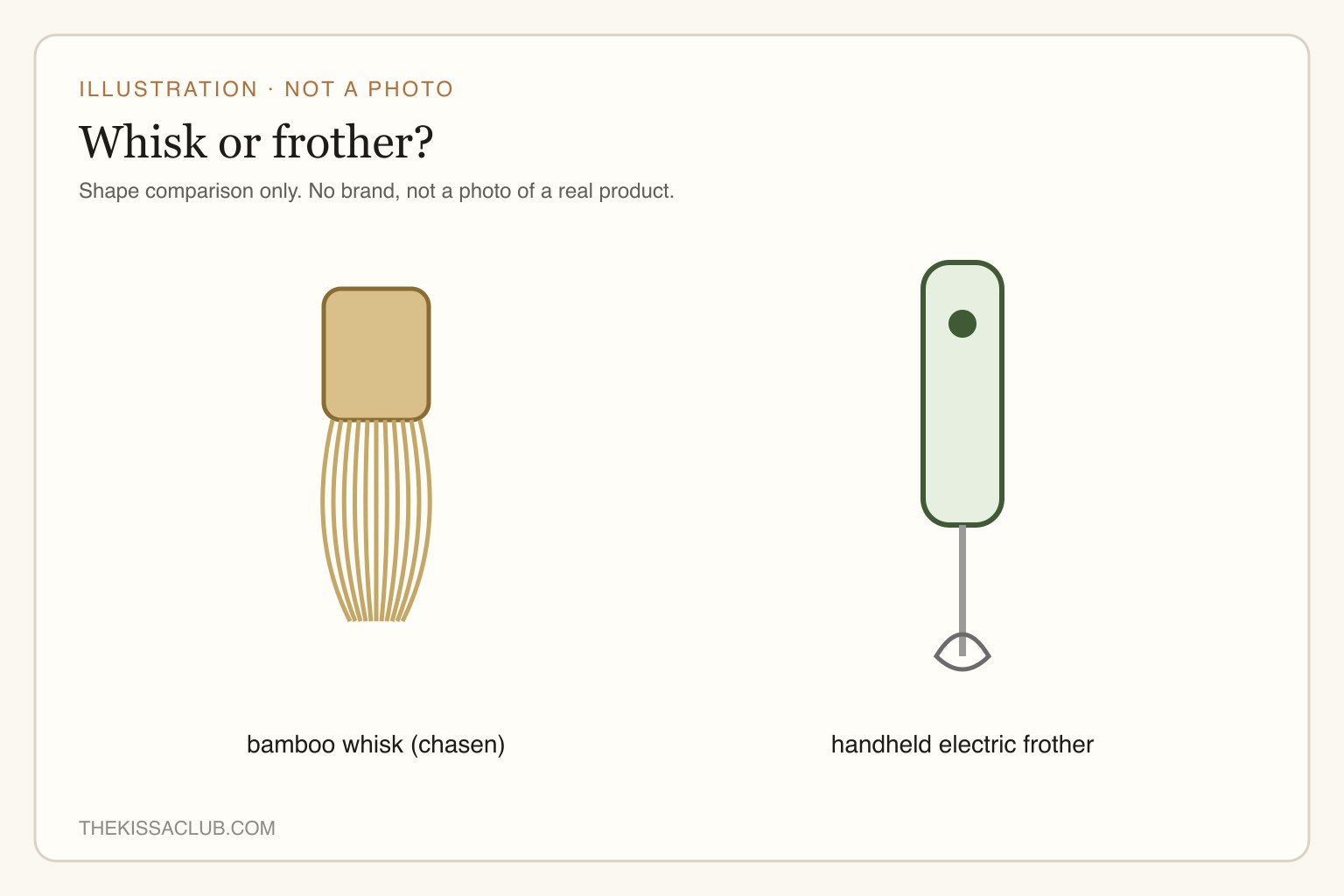
Short answer: if you drink matcha straight, with water, buy the bamboo whisk. If you mostly make lattes and don’t want to learn a technique, the electric frother does the job for less thought. They’re not really competing for the same cup — one is built for foam you can taste the difference in, the other is built for speed. Here’s which one actually fits how you drink it, with real prices from the same brand so you’re comparing apples to apples.
I’ll say upfront: we haven’t tested either tool ourselves. This comparison is built from the maker’s own product pages and what reviewers who have used both report, so there’s no taste test in it. We may earn a commission if you buy through links in this article, at no extra cost to you.
What each tool is actually doing
A bamboo whisk (chasen) has around 80 fine tines that whip matcha and water into a fine, stable foam through a fast W-shaped motion. It’s a mechanical skill — not a hard one, but one you build over a few tries. Our how to make matcha at home guide covers the motion and the mistakes that make it harder than it needs to be.
An electric frother is a small battery-powered spinner — think a tiny immersion blender — that does the aerating for you. Drop it in, hold the button, and reviewers describe a smooth froth within seconds. No wrist motion to learn, no 80 tines to keep from snapping.
Neither tool is “better” in the abstract. They’re built for different jobs.
The two products, compared
These are Jade Leaf’s own current listings — the same maker sells both, which makes this an easier comparison than most “bamboo vs electric” roundups that mix brands. Checked via product listings on November 20, 2026.
| Bamboo whisk + scoop | Electric whisk / milk frother | |
|---|---|---|
| Price | About $15 for the pair | $19.99 |
| Power source | None | 2 AA batteries (included or not varies by seller — check the listing) |
| Learning curve | A few tries to get the W-motion smooth | Press and hold |
| Best for | Plain matcha (usucha), traditional feel | Lattes, speed, no technique required |
| Foam quality on plain matcha | Fine, stable, long-lasting | Coarser, settles faster, per most reviewers |
| On a latte | Works, but milk hides the difference anyway | Built for exactly this |
| Care | Rinse, air-dry on a stand; tines are a consumable | Wipe clean; dishwasher-safe claims conflict between sellers — check before you run it through one |
| Travel-friendly | Awkward; tines bend in a bag | Compact; runs on batteries |
If you drink it plain, the whisk wins — and here’s why that’s not just tradition talk
For straight matcha whisked with water, the bamboo whisk’s fine tines produce foam that holds its texture longer and tastes smoother — that’s the consistent finding across reviewers who’ve actually run both tools side by side, and it lines up with why the traditional method never got replaced at tea houses that could easily afford electric gear. An electric frother’s spinning head makes bigger, airier bubbles that collapse faster and can read as sharper on the tongue.
If usucha — thin tea, whisked with water, drunk straight — is your actual habit, don’t buy the gadget to save twenty seconds. Jade Leaf’s bamboo whisk-and-scoop pair (affiliate link — we may earn a commission; the price is the same for you) is about $15, cheaper than the frother, and the better cup is the whole point of making it at home instead of buying it at a café. Ceremonial vs culinary matcha covers which grade of tea actually deserves that whisk.
If you’re making lattes, the gap mostly closes
Here’s where the comparison gets more interesting than most guides let on: once milk is in the cup, the foam-quality gap that matters for plain matcha matters much less. Milk covers texture differences that would be obvious in a bowl of straight tea. That’s exactly why Jade Leaf’s own Barista Edition tin — the one built specifically for lattes — exists separately from their plain-drinking Teahouse line, a split our best matcha powder guide covers in more detail.
For a daily latte habit, the frother’s real selling points aren’t foam quality — they’re convenience. No wrist technique to learn, no delicate tines to accidentally snap, and it’s done before a proper whisking even gets going. If you’re making this drink before work on a weekday, that’s not a small thing. Jade Leaf’s electric frother (affiliate link — we may earn a commission; the price is the same for you) is the one checked for this guide, at $19.99.
Worth knowing before you buy: seller listings disagree on a couple of details. Some say the frother ships with 2 AA batteries included, others list them as sold separately. Dishwasher-safety claims conflict the same way — one listing says yes, another says no. Neither detail is the kind of thing worth guessing on, so read the actual listing on whichever site you’re ordering from before you check out.
What it actually costs to set up either way
The whisk path isn’t just the whisk. Our matcha starter kit guide breaks down the full setup: the $12–20 whisk (or Jade Leaf’s $15 whisk-and-scoop pair), a bowl you probably already own, a $5–10 sifter, and an optional $8–15 stand that roughly doubles the whisk’s life. Add it up and you’re at $25–50 in tools before the tea itself.
The frother path is simpler on paper — $19.99 and you’re done — but it’s not actually zero extra cost. You still want to sift your matcha first; clumps don’t disappear just because the tool spins faster. And batteries are a small recurring cost a bamboo whisk never has. Jade Leaf also sells the frother bundled into a modern starter set alongside a sifter and scoop, which is worth a look if you already know electric is the direction you want and don’t want to buy the pieces separately.
Neither setup needs the $200 “complete tea ceremony set.” That’s décor for a different hobby entirely.
Can you just skip the whisk and shake it in a jar?
If you’re not sure yet whether matcha is even going to be a habit, yes — our how to make matcha at home guide includes a jar-and-shake method that needs neither tool. Make a few bowls that way first. Buy either gadget once you catch yourself wanting a better cup. Skip it while you’re still deciding if you like the drink at all.
And if the honest answer is “I want this for an iced latte, every morning, as fast as possible” — that’s the iced matcha latte recipe use case, and it’s the one place the frother’s speed advantage is hardest to argue with.
So which one should you buy?
Match the tool to the cup you actually drink most mornings, not the one that looks better in a photo:
- Mostly plain matcha, water, no milk: the bamboo whisk. Better foam, lower cost, and it’s the tool this drink was built around.
- Mostly lattes, mornings are rushed, you don’t want to learn a technique: the electric frother. You’re trading a small amount of foam quality for real convenience, and milk hides most of what you’re trading away.
- Both, depending on the day: plenty of people end up owning both, and at $15 and $20 respectively, that’s not a painful decision to make twice.
FAQ
Is an electric matcha frother as good as a bamboo whisk? For lattes, close enough that most people won’t notice. For plain matcha whisked with water, reviewers consistently say the bamboo whisk produces finer, longer-lasting foam.
Do I need to buy a sifter if I get the electric frother? Yes, still worth it. A frother spins matcha into foam faster than a whisk, but it doesn’t break up clumps any better. Sift first either way.
Does the Jade Leaf electric frother come with batteries? Listings disagree — some include 2 AA batteries, some don’t. Check the specific listing you’re ordering from before you buy.
Can I use a bamboo whisk for a latte? Yes, that’s actually the traditional method — whisk a concentrate with a little hot water, then pour it over milk. It works fine; the frother just saves you the motion.
Quick recap:
- Bamboo whisk wins on plain matcha. Electric frother wins on convenience for lattes.
- Both are sold by the same maker here, at about $15 and $20 — this isn’t really a budget decision either way.
- Check the actual listing for battery inclusion and dishwasher safety before you order; sources disagree on both.
Whisking it plain tomorrow morning, or pouring it over ice with milk? Check the bamboo whisk-and-scoop pair (affiliate link) if it’s the former, or check the electric frother and current price (affiliate link) if it’s the latter.
Kissa-ou ni, ore wa naru! (I’m gonna be the Kissa King!)
From the Kissa Club kitchen
The Home Kissa Guide
Everything on this site, organized into one book: brewing guides for matcha, sencha, hojicha & genmaicha, 40 café-style recipes, printable recipe cards, and the buying cheat sheet Japanese shoppers actually use. $19, instant download.
Get the guide →Want matcha that actually tastes like Japan?
Grab the free 5-Minute Matcha Cheat Sheet — ratios, temperatures, and the 3 mistakes to avoid, on one printable page.
Send me the cheat sheet →